
The Thermal Anchor Protocol: Using Fluid Anomaly Vectors of Water at 4°C for Passive Cooling Systems in Secure Farm Clusters
Water is at its densest at 4°C, not at freezing — a quirk of physics that lets a buried, insulated reservoir act as a stable cold anchor for greenhouse cooling, circulated entirely by density difference rather than a pump.
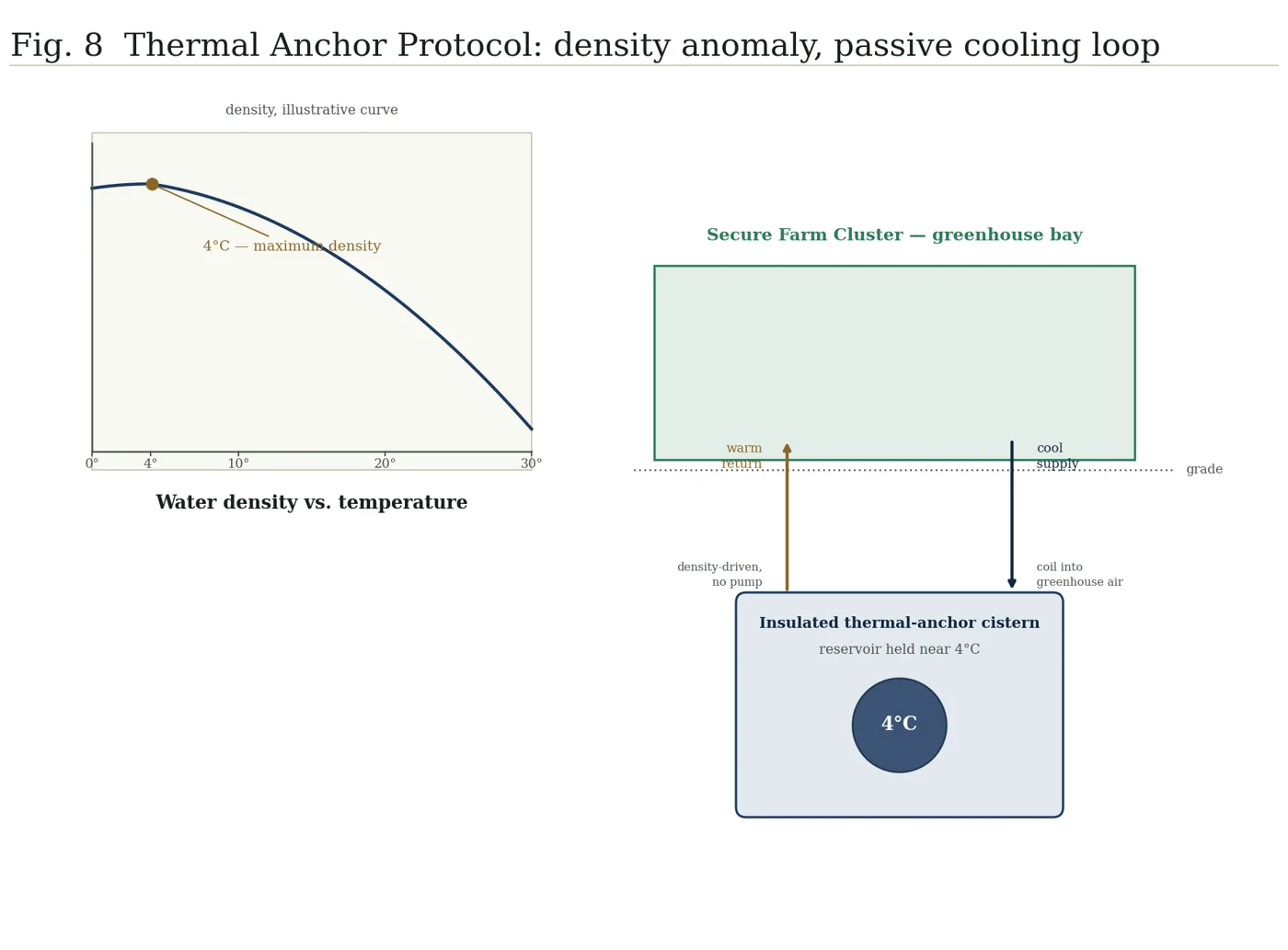
Water does something almost no other common liquid does: it reaches maximum density not at its freezing point but at roughly 4°C, then becomes progressively less dense both as it warms further and as it cools toward freezing. That anomaly is why a lake freezes from the top down instead of the bottom up — the densest water sinks and settles near the bottom while colder, lighter water and eventually ice stay near the surface. The Thermal Anchor Protocol borrows the same physics deliberately, using a buried reservoir of water near 4°C as a stable, self-sustaining cold source for passive greenhouse cooling on ArthAxis GROW’s secure farm clusters.
The mechanism is a thermosiphon, not a pump. An insulated cistern buried below the frost and heat line stays close to the site’s mean annual groundwater temperature — in Aligarh’s climate, reliably cooler than daytime greenhouse air for most of the growing season. Warmer air passing through a coil draws heat into circulating water; that warmed water becomes marginally less dense, rises, and is displaced by cooler, denser water from the reservoir below. The circulation is driven entirely by the density gradient the anomaly creates — no pump, no compressor, and no electrical load beyond the sensors monitoring it.
This matters specifically for the “secure” half of the protocol’s target use case. A secure farm cluster is, by definition, a site where continuous climate control can’t depend on an uninterrupted grid connection — the same power and telemetry failure risk already flagged in ArthAxis GROW’s own risk matrix as a medium-impact, high-likelihood threat. A thermosiphon loop keeps working through exactly the kind of grid outage that stops an active compressor-based cooling system cold, because its only moving part is the water itself.
The protocol is not a replacement for active refrigeration — it is a buffer. A 4°C anchor reservoir can shave several degrees off a greenhouse’s peak daytime temperature and meaningfully slow the rate of temperature swing, but it does not hold a chamber at a fixed set point the way a compressor-driven cold storage unit does. In practice it pairs naturally with the insulation-first design principles already laid out in ArthAxis’s cold storage design guide — the reservoir buys time and reduces load, the insulated envelope keeps what it buys from leaking back out.
Feasibility is site-specific rather than universal, which is why the protocol is scoped to secure farm clusters rather than proposed as a general-purpose cooling system. It depends on a reliably cool groundwater or borewell source, adequate depth to bury an insulated cistern below seasonal heat penetration, and a greenhouse structure already built with the coil and insulation detailing to use a passive loop efficiently. Where those conditions hold — as they do across ArthAxis GROW’s Aligarh sites — the protocol adds a genuinely low-maintenance layer of climate resilience on top of the structural reinforcement and automated climate control already specified for flood and heat-wave risk.
Part of the ArthAxis Research Lab. Builds on R-01: ArthAxis Planning Theory. Read the citation →
More from ArthAxis Research Lab
ArthAxis Planning Theory
The internal framework behind every ArthAxis master plan — one spatial pattern, read at every scale from a nation down to a single courtyard.
R-02 · 7 MINFort-Gate Urbanism
A defensive fort-and-gate settlement pattern, translated into a hexagonal "honeycomb" topology — so a city, campus or farm site has more than one way to keep functioning when a single route fails.
R-03 · 6 MINThe Techno-Organic Harmony Model
An algorithmic substrate for keeping a building, plaza or farm site in active symbiosis with the biological life around it — not just leaving room for a few trees at the boundary.