
The Techno-Organic Harmony Model: Designing Infrastructure to Coexist With Its Ecosystem
An algorithmic substrate for keeping a building, plaza or farm site in active symbiosis with the biological life around it — not just leaving room for a few trees at the boundary.
Most sustainability briefs treat ecology as a constraint to be accommodated: a minimum green-cover ratio, a setback for existing trees, a landscaping budget line. The Techno-Organic Harmony Model treats it as an active feedback loop instead — a sensing and control layer that keeps the built environment and the biological systems around it responding to each other in real time, rather than two separate things that happen to share a boundary.
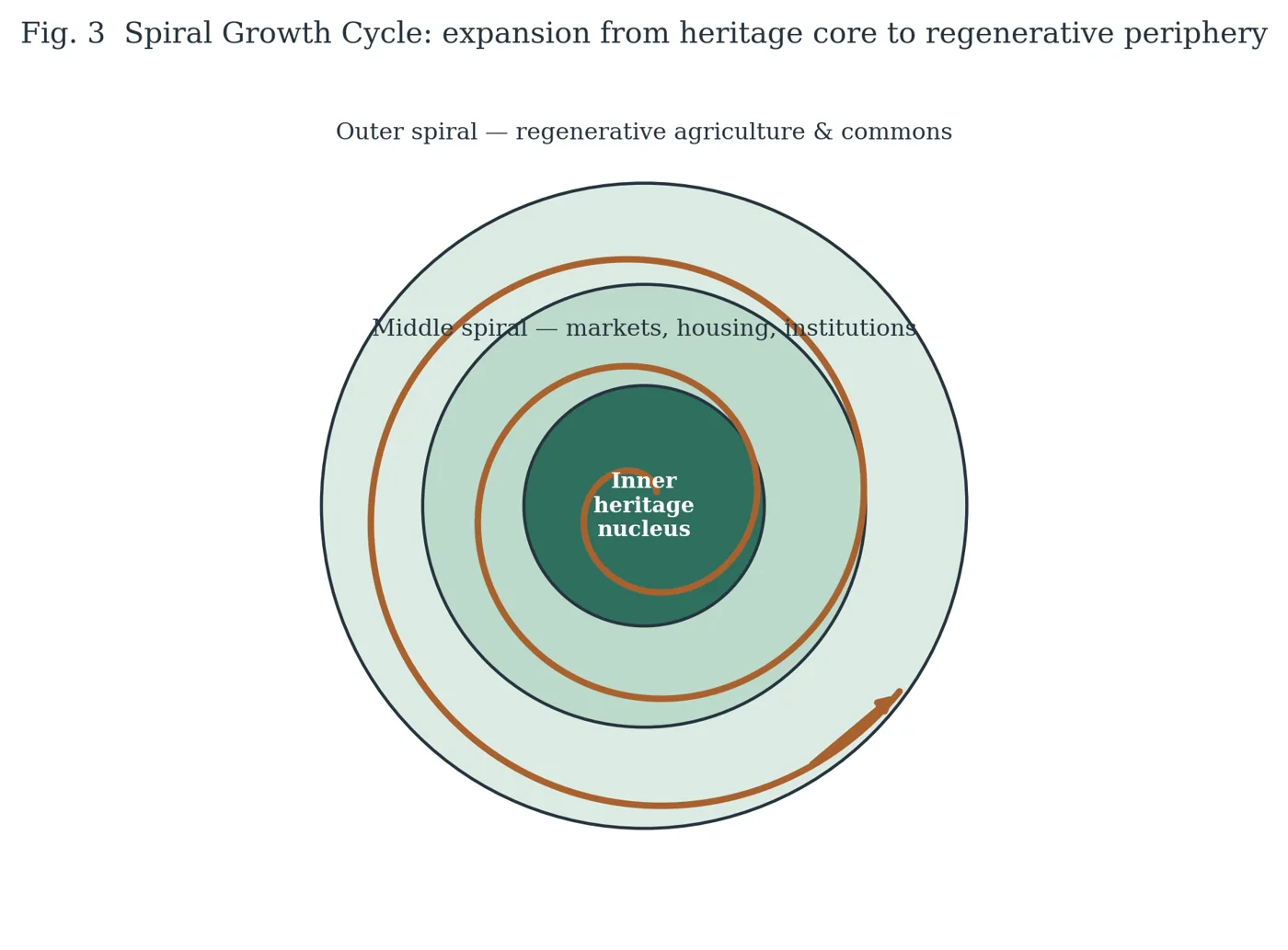
The clearest picture of the model is a spiral, expanding outward from an inner heritage nucleus through a middle band of markets, housing and institutions, into an outer band of regenerative agriculture and commons. The point of the spiral, rather than a conventional expanding grid, is proximity: every layer of the built environment stays a short walk from the ecological layer, instead of pushing green space to the far edge of a masterplan where it rarely gets used or maintained.
"Algorithmic substrate" is a specific claim, not a slogan — it is the same DoubleSlit AI sensing layer already running on the iViRTH × InfiniOX AI Smart Solar Bench network, redirected at biological rather than just human activity: soil moisture, canopy cover, air quality and water-table telemetry feeding back into how a site's irrigation, shading and drainage actually behave, rather than sitting in a dashboard nobody checks. ArthAxis GROW's automated hydroponic and aquaponic controllers across the Aligarh sites are a working, field-scale example of this today.
A Site 2-style multi-method farm hub already runs a small version of the full model: closed-loop aquaponic filtration is literally biological life — fish, plants, filtering bacteria — and hardware — pumps, sensors, dosing controllers — sharing one continuous feedback loop, each correcting for the other. Techno-Organic Harmony scales that same principle up from a single greenhouse to landscape architecture and township commons, using the same sensor backbone rather than a bespoke system for every site.
The same logic increasingly shows up under the Landscape Architecture & Urban Parks Upgradation vertical (V4) too — native softscape and hardscape planning for civic parks paired with the sensor backbone already proven on GROW and Smart Bench deployments, so a public park's irrigation and lighting respond to live environmental data rather than a fixed timer.
Techno-Organic Harmony is really the "input" half of a larger idea. The companion piece on the Waste-to-Wealth Framework covers the other half — making sure nothing leaves that same loop uncounted.
Part of the ArthAxis Research Lab. Builds on R-01: ArthAxis Planning Theory. Read the citation →
More from ArthAxis Research Lab
ArthAxis Planning Theory
The internal framework behind every ArthAxis master plan — one spatial pattern, read at every scale from a nation down to a single courtyard.
R-02 · 7 MINFort-Gate Urbanism
A defensive fort-and-gate settlement pattern, translated into a hexagonal "honeycomb" topology — so a city, campus or farm site has more than one way to keep functioning when a single route fails.
R-04 · 6 MINThe Waste-to-Wealth Framework
Turning a site's waste stream into a sorted, tracked input rather than an unexamined output — using the same AI sensing layer already deployed across ArthAxis's IoT hardware.