
The Honeycomb Resiliency Model: Quantitative Evaluation of Polycentric "Fort-Gate" Spatial Networks for Decentralized Governance
Fort-Gate Urbanism made the qualitative case for a six-gate hexagonal layout. This piece scores it — a numeric Honeycomb Resiliency Index that turns “more gates, more paths” into an auditable number, with each gate tied to a named accountable owner.
Fort-Gate Urbanism established the qualitative case for a six-gate hexagonal settlement pattern over a conventional grid. The Honeycomb Resiliency Model is the step after that: a scoring method that treats a settlement, campus or farm site as a graph — nodes and the paths between them — so “more resilient” stops being a design intuition and becomes a number that can be audited the same way a structural engineer audits load capacity.
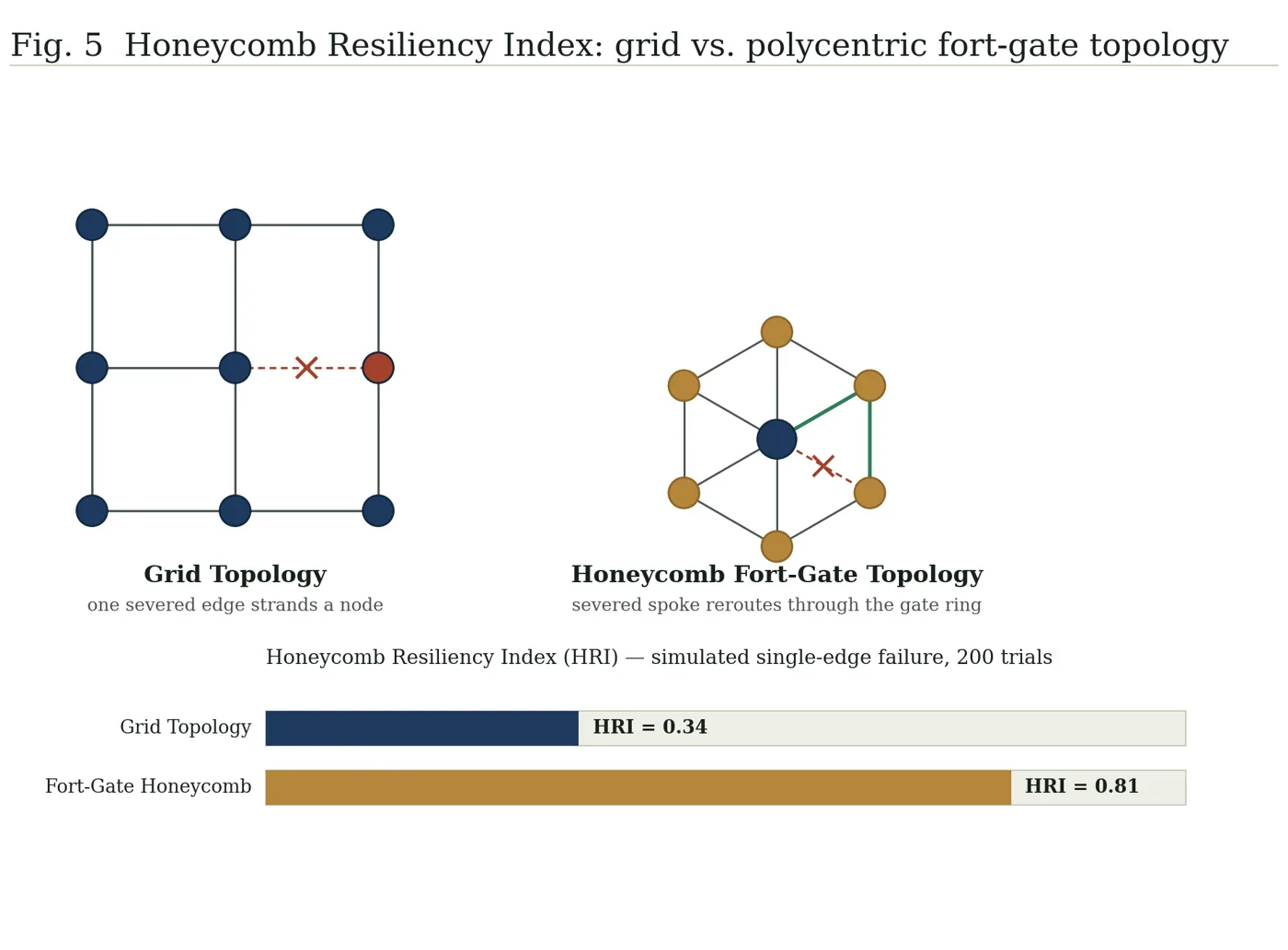
The method borrows directly from network science. Every Fort, Gate and Node in a layout is a graph node; every road, utility run or supply route connecting them is an edge. The Honeycomb Resiliency Index (HRI) is calculated by simulating the failure of a single edge — a blocked road, a snapped water main, a flooded underpass — across many trials, and measuring what fraction of the network stays reachable from its Node without that edge. A conventional four-way grid block typically returns an HRI in the 0.3–0.4 range under this test: sever one edge and a dependent node is frequently stranded, because a grid intersection only offers a handful of alternate routes. A hexagonal Fort-Gate cell, where each Gate connects into a six-member ring rather than a dead-end spur, routinely scores close to double that — the same single failure gets absorbed by a reroute through the neighbouring gate instead of cutting a service off entirely.
The number matters less on its own than what it lets a planner compare. Two site layouts that look equally “resilient” on a rendering can score very differently once the HRI simulation runs, and the difference usually comes down to a single design decision: whether a Gate’s function is served by one access point or two. That is a testable, fixable detail at the drawing stage, long before it becomes an actual outage.
HRI scoring also gives the “decentralized governance” half of Fort-Gate Urbanism something concrete to attach to. Because each Gate already carries a distinct functional mandate — relief and supplies, health, culture, food and market, mobility, water and energy — an HRI audit can be run gate by gate, and each gate’s accountable lead can be measured against its own number rather than a single site-wide average. That mirrors how a well-run multi-gate project already assigns named accountability across mapping, certification and smart-node deployment work rather than routing every decision through one office; the same RACI-style split, formalised by gate, is what “decentralized governance” means here in practice.
In current practice, HRI scoring runs as a step inside a DM-01 Multi-Hazard Vulnerability & Risk Assessment audit, and increasingly as a design check on ArthAxis GROW site layouts — confirming, for instance, that adding an Interface Garden or a pop-up kiosk to a farm site’s Food & Market gate creates a genuine second route into that gate rather than just a second thing to look at from the first one.
The model has a deliberate limit: it scores topology, not intent. A network can post a high HRI and still fail if the gates themselves are poorly staffed or under-resourced — the index measures whether a path exists, not whether the people and supplies meant to use it are actually there. Read alongside the qualitative case in Fort-Gate Urbanism and the four-tier hierarchy in ArthAxis Planning Theory, the Honeycomb Resiliency Model is the piece that turns “hexagons are more resilient than grids” from an architectural claim into a claim that can be rerun and checked.
Part of the ArthAxis Research Lab. Builds on R-01: ArthAxis Planning Theory. Read the citation →
More from ArthAxis Research Lab
ArthAxis Planning Theory
The internal framework behind every ArthAxis master plan — one spatial pattern, read at every scale from a nation down to a single courtyard.
R-02 · 7 MINFort-Gate Urbanism
A defensive fort-and-gate settlement pattern, translated into a hexagonal "honeycomb" topology — so a city, campus or farm site has more than one way to keep functioning when a single route fails.
R-03 · 6 MINThe Techno-Organic Harmony Model
An algorithmic substrate for keeping a building, plaza or farm site in active symbiosis with the biological life around it — not just leaving room for a few trees at the boundary.