
Carbon Footprint Tokens (CFT): Real-Time IoT Tracking Arrays for Environmental Citizenship and Ecological Asset Formation
A proposed internal ledger that converts a Smart Bench’s solar generation, a GROW site’s avoided emissions, or a resident’s verified recycling into a countable, sensor-backed credit — an ESG accounting layer, not a cryptocurrency.
Most carbon accounting still runs on self-reported estimates: a household or a facility manager fills in an annual questionnaire, and an emissions figure gets extrapolated from averages rather than measured. Carbon Footprint Tokens (CFT) propose a different starting point — treat carbon savings the way the Waste-to-Wealth Framework treats a waste stream: as something a sensor actually counts as it happens, rather than something a form estimates afterward.
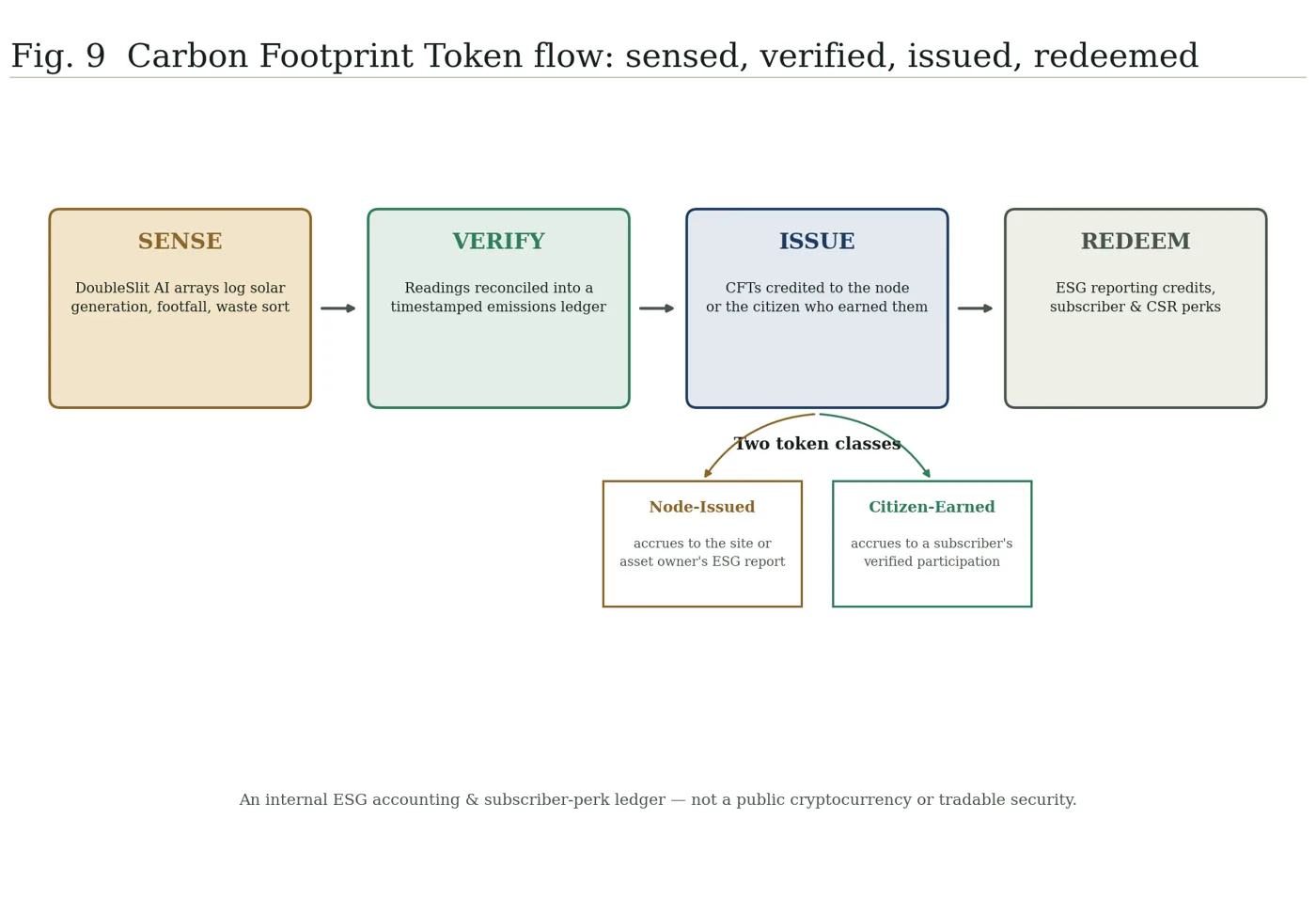
The sensing layer already exists. DoubleSlit AI arrays across the AI Smart Solar Bench network already log solar generation in real time — each unit’s off-grid design already displaces an estimated 0.5 to 0.7 tonnes of CO₂ per year that would otherwise come from grid electricity. The same sensing family already logs footfall, and, through the Waste-to-Wealth sorting stations, waste composition as it’s generated. A CFT is simply what happens when those readings are reconciled into a timestamped ledger entry instead of being left to sit in separate dashboards.
The framework proposes two token classes, split by who generated the underlying saving. A Node-Issued token accrues to the infrastructure itself — a Smart Bench’s verified solar offset, for instance — and rolls up into the site or asset owner’s own ESG reporting, giving a developer or a municipal client a sensor-backed number to cite instead of a modelled estimate. A Citizen-Earned token accrues to an individual’s own verified participation: a GROW subscriber returning produce-box packaging for reuse, or a resident’s confirmed use of a site’s composting loop, both already tracked as the first two waste streams the Waste-to-Wealth Framework actively measures.
“Environmental citizenship” is the deliberate framing for the citizen-earned half of the model — it treats verified, small-scale environmental participation as something that accumulates and is worth recognising, rather than something that only shows up in aggregate municipal statistics. In practice that recognition is modest and non-financial: subscriber perks on a GROW plot, or preferential terms on a future reservation, redeemed against a real, sensor-confirmed record rather than a claimed one.
It is worth being precise about what a CFT is not. The framework is an internal accounting and loyalty ledger — a way of giving ESG reports and subscriber perks a verifiable sensor trail — not a public cryptocurrency, a tradable security, or a claim of financial value outside ArthAxis’s own systems. That distinction matters both practically and for anyone evaluating the model: the value of a CFT is the accuracy of the sensor reading behind it, not a market price.
As a companion to Waste-to-Wealth, CFT is really the accounting layer sitting on top of the sensing that framework already describes — Waste-to-Wealth establishes that nothing leaves a site uncounted; Carbon Footprint Tokens are the proposed ledger that gives each of those counted savings an owner and a use.
Part of the ArthAxis Research Lab. Builds on R-01: ArthAxis Planning Theory. Read the citation →
More from ArthAxis Research Lab
ArthAxis Planning Theory
The internal framework behind every ArthAxis master plan — one spatial pattern, read at every scale from a nation down to a single courtyard.
R-02 · 7 MINFort-Gate Urbanism
A defensive fort-and-gate settlement pattern, translated into a hexagonal "honeycomb" topology — so a city, campus or farm site has more than one way to keep functioning when a single route fails.
R-03 · 6 MINThe Techno-Organic Harmony Model
An algorithmic substrate for keeping a building, plaza or farm site in active symbiosis with the biological life around it — not just leaving room for a few trees at the boundary.